
Dk 2.20±0.02 · Df 0.0009 @ 10 GHz · stable 2.18–2.22 from 1 MHz to 40 GHz · 0.02% moisture absorption — the parameters behind RT/duroid® 5880.
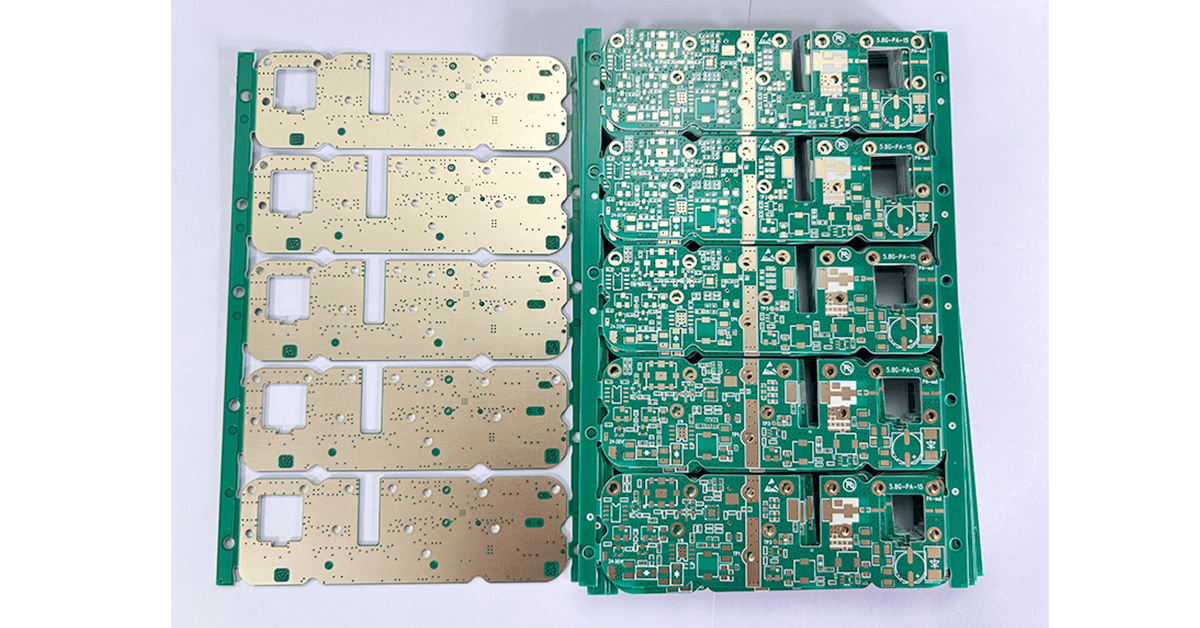
The Short Answer
Bottom line up front: Rogers RT/duroid® 5880 is a PTFE glass-microfiber laminate with Dk 2.20±0.02 and Df 0.0009 at 10 GHz, moisture absorption of just 0.02%, and a dielectric constant that barely moves — 2.18 to 2.22 — across the entire 1 MHz to 40 GHz range. It is one of the lowest-loss laminates available for microwave and millimeter-wave circuits.
This page breaks down the parameters behind those numbers and what each one means in production.
Material Construction: PTFE with Glass Microfiber
RT/duroid® 5880 is built on polytetrafluoroethylene (PTFE) reinforced with glass microfibers that are randomly distributed within the material. The random orientation is deliberate: it gives the laminate maximum mechanical strength during circuit application and production, without creating the direction-dependent dielectric behavior you get from woven-glass reinforcements.
The result is a soft, easily machinable laminate that still holds its shape through lamination, drilling, and plating — a combination that exotic pure-PTFE constructions struggle to match.
Main Parameters at a Glance
| Parameter | Value | What it means for your design |
|---|---|---|
| Dielectric constant (Dk) | 2.20±0.02 @ 10 GHz (IPC-TM 2.5.5.5) | Precise impedance control; lowest Dk among comparable laminates |
| Dk variation across frequency | 2.18–2.22 from 1 MHz to 40 GHz | Predictable phase and impedance from MHz into mmWave |
| Dissipation factor (Df) | 0.0009 @ 10 GHz (IPC-TM 2.5.5.5) | Minimal signal attenuation; supports Ku-band and beyond |
| Moisture absorption | 0.02% | Stable electricals in high-humidity environments |
| Construction | PTFE with randomly distributed glass microfibers | Maximum strength reinforcement without Dk anisotropy |
| Plated copper range | 8–70 µm | Covers both fine-line RF and higher-current designs |
| Chemical resistance | Withstands etching and plating-through-hole reagents | Reliable through full manufacturing cycle |
Electrical Characteristics Explained
Dk 2.20±0.02 @ 10 GHz. Measured under the IPC-TM 2.5.5.5 standard, this is among the lowest dielectric constants of any comparable laminate. Low Dk reduces signal propagation delay and allows wider, more forgiving trace geometries for a target impedance.
Dk stability from 1 MHz to 40 GHz. Across that full span the constant only drifts between 2.22 and 2.18. For designers this means an impedance model calibrated at one frequency still holds at another — critical for broadband amplifiers, phased arrays, and systems mixing RF and mmWave sections on one board.
Df 0.0009 @ 10 GHz. Extremely low dielectric loss keeps signal attenuation down and preserves signal quality, supporting high-frequency, broadband applications that need minimized dispersion — with usable performance up to the Ku band and beyond.
Physical and Mechanical Characteristics
Moisture absorption 0.02%. Nearly hermetic behavior: electrical properties stay stable in high-humidity environments, which is why 5880 is a default choice for outdoor communication equipment, marine systems, and aerospace hardware.
Easy to cut and shape. The laminate cuts cleanly into custom outlines and cavity structures — a common requirement in high-frequency PCB designs where cavities house chip-scale components or control resonance.
Plated copper from 8 to 70 µm. A wide electroplated copper range supports everything from fine-line mmWave traces to higher-current bias lines on the same stackup.
Chemical resistance. The material withstands every solution and reagent used in etching and plated-through-hole processing, staying dimensionally and electrically intact through the full production cycle.
Where RT/duroid® 5880 Is Used
The parameter set maps directly onto real programs: microwave and millimeter-wave circuits, satellite communication payloads, radar and guidance systems, point-to-point radio links, and precision RF sensors. Anywhere low loss and a rock-steady Dk matter more than raw material cost, 5880 is on the shortlist.
Fabricating RT/duroid® 5880 at XCE PCB
5880 rewards a fabricator who runs PTFE-tuned processes — drilling parameters, desmear chemistry, and lamination cycles all differ from FR-4 practice. XCE PCB manufactures RT/duroid® 5880 boards from 2 to 72 layers, panels up to 600×1200 mm, with impedance held to ±10% and prototypes in as fast as 24 hours.
Send us your stackup and frequency band; our engineers will review manufacturability and return a quote with the process plan attached.
Conclusion
RT/duroid® 5880 earns its reputation with a rare combination: the lowest Dk in its class, near-zero loss, frequency stability from 1 MHz to 40 GHz, and near-zero moisture uptake — all in a laminate that is still easy to cut, plate, and process. If your design lives above a few GHz, it remains one of the safest material decisions you can make.
Frequently Asked Questions
What is Rogers RT/duroid 5880 laminate made of?
What is the dielectric constant of RT/duroid 5880 across frequency?
What copper thicknesses can be used with RT/duroid 5880?
Can RT/duroid 5880 be machined into custom shapes and cavities?
Is RT/duroid 5880 suitable for humid environments?
Need RT/duroid® 5880 boards?
Send us your Gerber files and requirements for a manufacturability review and a tailored quotation.
sales1@xcepcb.com
+86 180 3341 4657