
This analysis needed a correction before it could be trusted: an earlier version attributed 5880’s low loss to a “ceramic-filled hydrocarbon system” with FR-4-compatible processing. Both claims are wrong — RT/duroid 5880 is glass-microfiber-reinforced PTFE, and its processing is distinctly not standard. With the recipe fixed, the real loss story is more interesting: where the loss actually comes from, and which of the four contributors 5880 attacks.
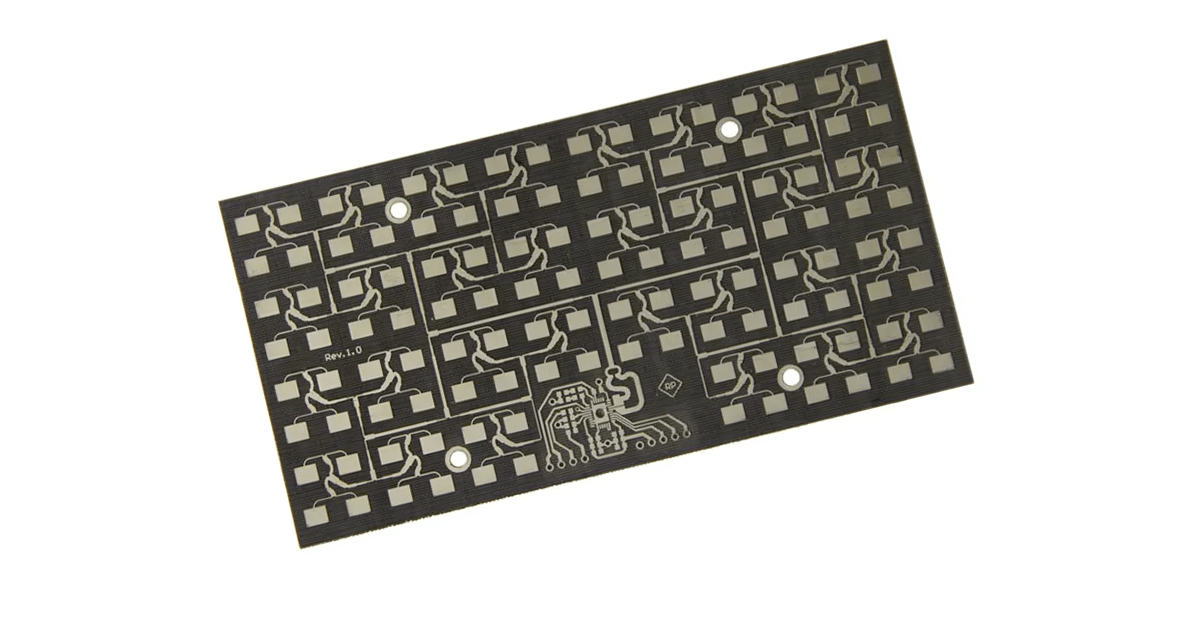
Correction: the Actual Recipe
RT/duroid 5880: PTFE matrix, randomly oriented glass microfiber. Dk 2.20 ± 0.02, Df 0.0009 @ 10 GHz, moisture absorption 0.02%, Z-CTE 237 ppm/°C. It is a thermoplastic system — the laminate never melts in a press the way epoxy does, which is why bonding films and PTFE-specific hole treatment exist. Every loss conclusion below follows from PTFE physics, not from any resin chemistry. Full material basis: the 5880 material walkthrough.
Where the Loss Comes From — Four Contributors
| Contributor | Driven by | 5880 answer |
|---|---|---|
| Dielectric loss | Df and polarization | Df 0.0009 — nonpolar PTFE has minimal molecular polarization; ~20× lower than FR-4 |
| Conductor loss | Foil roughness (skin effect) | Low Dk allows wider lines at the same impedance, cutting surface resistance; specify low-profile foil for mmWave builds |
| Radiation / leakage | Etch quality, phase consistency | Non-woven microfiber — no glass-weave skew, isotropic Dk, clean etched edges |
| Moisture-induced drift | Absorbed water (Dk ~80) | 0.02% absorption — effectively immune |
Note the conductor-loss row: foil treatment is a designer choice on 5880, not a laminate property. The tight Dk band (±0.02) is what makes phase-matched structures practical.
The Processing Price of the Loss Floor
Low loss is not free. 5880 demands: sodium-naphthalene or plasma hole activation before electroless copper (bare PTFE rejects metallization), bonding films or low-flow prepreg instead of ordinary lamination, drilling discipline on soft laminate, and Dk-aware impedance design. These are solved processes at any RF fabricator — but they are not FR-4 processes, and quotes that pretend otherwise produce boards that fail after reflow. The process specifics: the hybrid lamination guide and the drilling guide.
When Ultra-Low Loss Actually Pays
- Long mmWave runs — feed networks, beamforming manifolds, where every 0.1 dB is link budget.
- Phase-critical arrays — tight Dk band + isotropy = predictable electrical length.
- Outdoor / humid environments — 0.02% absorption keeps loss numbers valid in rain, unlike hydroscopic substrates.
- Not for digital speed — the Z-CTE 237 and softness rule out high-layer-count digital; there 5880 buys nothing. The material boundary is argued in the AI application analysis.
How XCE PCB Builds Ultra-Low Loss Boards
XCE PCB builds RT/duroid 5880 boards from 2 to 72 layers, impedance controlled to ±10%, panels up to 600 × 1200 mm, with sodium-naphthalene hole treatment as standard. Samples in as fast as 24 hours when laminate is in stock. Related: the 5G mmWave property analysis and the preferred-material case.
Frequently Asked Questions
Is Rogers 5880 a hydrocarbon laminate?
What is the dissipation factor of RT/duroid 5880?
Does copper foil roughness matter on 5880?
Quoting a 5880 Build?
Send us your Gerber files and requirements for a manufacturability review and a tailored quotation.
sales1@xcepcb.com
+86 180 3818 8537