
Dk 3.38 vs 3.00 · Df 0.0027 vs 0.0010 @ 10 GHz · thermoset vs PTFE chemistry — a practical comparison to help you pick the right Rogers laminate.
What Is Rogers RT/duroid® 4003C?
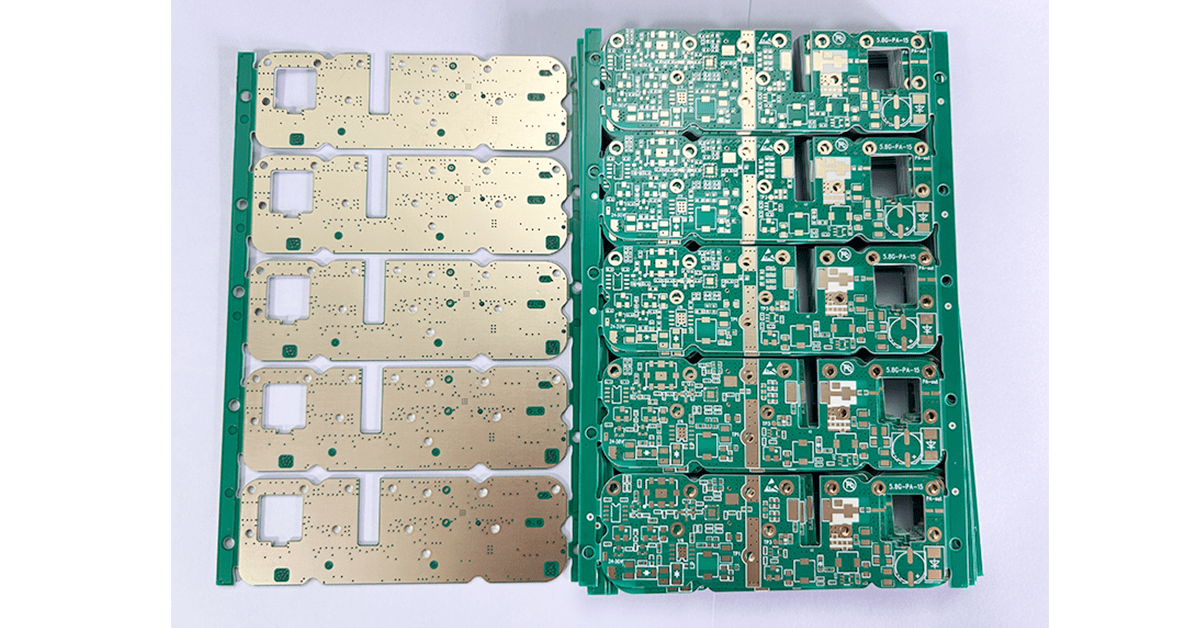
Rogers RT/duroid® 4003C (often written RO4003C) is a hydrocarbon/ceramic laminate cured with a thermoset resin system. It is not a PTFE material — a common misconception — and that is exactly why it has become one of the most widely used RF laminates in the world: it can be processed with standard FR-4 fabrication methods while still delivering true high-frequency performance.
Key characteristics of RO4003C include:
- Dk 3.38 ± 0.05 @ 10 GHz, tightly controlled for repeatable impedance
- Df 0.0027 @ 10 GHz — low loss for RF designs from hundreds of MHz up to several GHz
- Glass-reinforced structure with excellent mechanical rigidity
- UL 94 V-0 flammability rating and lead-free process compatible
Typical uses are base station power amplifiers, LNA circuits, radar sub-systems below the mmWave band, filters and couplers — anywhere a designer wants near-PTFE electricals without PTFE processing cost.
What Is Rogers RT/duroid® 3003?
Rogers RT/duroid® 3003 (RO3003) belongs to the RO3000 family: a PTFE-ceramic laminate with randomly-oriented ceramic filler. It was engineered for the strictest dielectric-constant consistency, which is why it has become the default substrate for 77 GHz automotive radar and other millimeter-wave sensors.
Key characteristics of RO3003 include:
- Dk 3.00 ± 0.04 @ 10 GHz with extremely tight lot-to-lot tolerance
- Df 0.0010 @ 10 GHz — roughly a third of the loss of RO4003C
- Very low dissipation factor maintained up to mmWave frequencies
- Stable mechanical and electrical behaviour across −55 °C to +288 °C
Because it is PTFE-based, RO3003 requires specialised fabrication: plasma or sodium-naphthenate hole preparation, careful lamination control and experienced process engineers. For a deeper look at the material itself, see our Rogers RT/duroid 3003 laminate overview.
Side-by-Side Parameter Comparison
The table below summarises the datasheet values that matter most in material selection:
| Property (typical) | RO4003C | RO3003 |
|---|---|---|
| Resin system | Hydrocarbon/ceramic, thermoset | PTFE + ceramic filler |
| Dk @ 10 GHz | 3.38 ± 0.05 | 3.00 ± 0.04 |
| Df @ 10 GHz | 0.0027 | 0.0010 |
| Glass reinforcement | Yes (woven glass) | No |
| Thermal conductivity | 0.71 W/m/K | 0.65 W/m/K |
| Z-axis CTE (50–150 °C) | 46 ppm/°C | 25 ppm/°C |
| Moisture absorption | 0.06% | 0.06% |
| Fabrication | Standard FR-4 process | PTFE process (plasma/Na etch) |
| Sweet spot | RF up to ~10–20 GHz | mmWave, incl. 77 GHz radar |
Both laminates absorb very little moisture, so the real decision drivers are resin chemistry, loss at your operating frequency and fabrication cost.
Difference 1: Resin Chemistry and Processing
This is the most consequential difference. RO4003C’s thermoset resin system behaves like a high-end FR-4: it can be sheared, drilled, multilayer-laminated and tin-leveled on the same line as conventional boards, with no special hole-wall treatment. That keeps both cost and lead time down.
RO3003, being PTFE-based, needs dedicated handling: PTFE laminates do not wett with standard drilling desmear chemistry, so via holes require plasma etch or sodium-naphthenate treatment before plating. Lamination cycles also differ from FR-4. The result is a slower, more specialised and more expensive fabrication flow — justified only when the electrical benefits are genuinely needed.
Difference 2: Dielectric Loss and Frequency Range
At 10 GHz the numbers look close-ish (0.0027 vs 0.0010), but loss scales with frequency. As designs move into the millimeter-wave region, RO4003C’s loss rises noticeably while RO3003 keeps its advantage — at 77 GHz the gap is the difference between a working radar and a marginal one. RO3003’s lack of woven glass also removes the local Dk variation (fiber-weave effect) that matters for phase-sensitive mmWave circuits.
Below roughly 10–20 GHz, however, RO4003C delivers comfortably acceptable loss at a notably lower total cost, which is why it dominates commercial RF front-ends. If you are weighing Rogers laminates against each other more broadly, our 5880 vs 5870 comparison and RO5880 advantages article cover the high-end PTFE options.
Difference 3: Thermal and Mechanical Reliability
RO3003’s Z-axis CTE of 25 ppm/°C is closer to copper than RO4003C’s 46 ppm/°C, giving RO3003 an edge in plated through-hole reliability across wide temperature swings — relevant for automotive under-hood and outdoor telecom hardware.
RO4003C counters with mechanical stiffness from its woven-glass reinforcement, which helps with panel handling, fixtures and large-format assemblies. Its higher thermal conductivity (0.71 vs 0.65 W/m/K) is a minor advantage for power amplifiers. Neither material has issues with typical solder-reflow profiles; RO4003C’s thermoset system carries a Tg above 280 °C.
Which Material Should You Choose?
Use this quick mapping:
- Choose RO4003C for cellular base stations, RF power amplifiers, LNA/mixers, filters, connectors-to-PCB transitions and cost-sensitive radar below mmWave — maximum performance per dollar up to ~20 GHz.
- Choose RO3003 for 77 GHz automotive radar, 60 GHz WiGig, mmWave point-to-point links, phased-array antennas and any design where phase stability and lowest loss at mmWave matter more than cost.
If your stack-up mixes RF sections with digital logic, also consider RO4350B, which pairs FR-4 processing with a Dk of 3.48 and bonds well to FR-4 prepreg in hybrid multilayers.
How XCE PCB Manufactures Both Materials
XCE PCB fabricates Rogers laminates in volume under one roof — 2 to 72 layers, impedance controlled to ±10%, panel format up to 600 × 1200 mm, with sample lead times as fast as 24 hours. Our 5,000 m² facility runs dedicated PTFE processing (plasma desmear, controlled lamination) alongside a standard FR-4 line, so RO4003C and RO3003 — including hybrid RO3003/FR-4 stack-ups — can be produced and verified in-house by 80+ experienced engineers, backed by more than 10,000 delivered projects since 2009.
Conclusion
RO4003C and RO3003 solve different problems. RO4003C brings near-PTFE electricals to a standard FR-4 workflow — the pragmatic choice for RF designs up to roughly 20 GHz. RO3003 trades fabrication convenience for the tightest Dk control and lowest loss at mmWave, where 77 GHz radar lives. Match the resin chemistry to your frequency, reliability and budget requirements, and either laminate will deliver long-term stability.
Frequently Asked Questions
Is RO4003C a PTFE material?
Which is better for 77 GHz automotive radar, 4003C or 3003?
Can RO4003C and RO3003 be fabricated on the same line?
Do RO4003C and RO3003 have the same dielectric constant?
Which material is cheaper to build a PCB with?
Need Help Choosing Between RO4003C and RO3003?
Send us your Gerber files and requirements for a manufacturability review and a tailored quotation.
sales1@xcepcb.com
+86 180 3818 8537