
The TLX series is Taconic’s woven-fiberglass PTFE workhorse — but it is a family, not a single material. Circulating summaries that quote “TLX: Dk 2.55” are quoting one grade (TLX-8) as if it were the whole series. The real picture: five grades from TLX-0 to TLX-6 covering Dk 2.45–2.65 in ±0.04 steps, all sharing Df ≈0.0019 @ 10 GHz and a construction that trades a fraction of the TLY series’ loss for woven-glass rigidity that survives shearing, drilling and multilayer lamination.
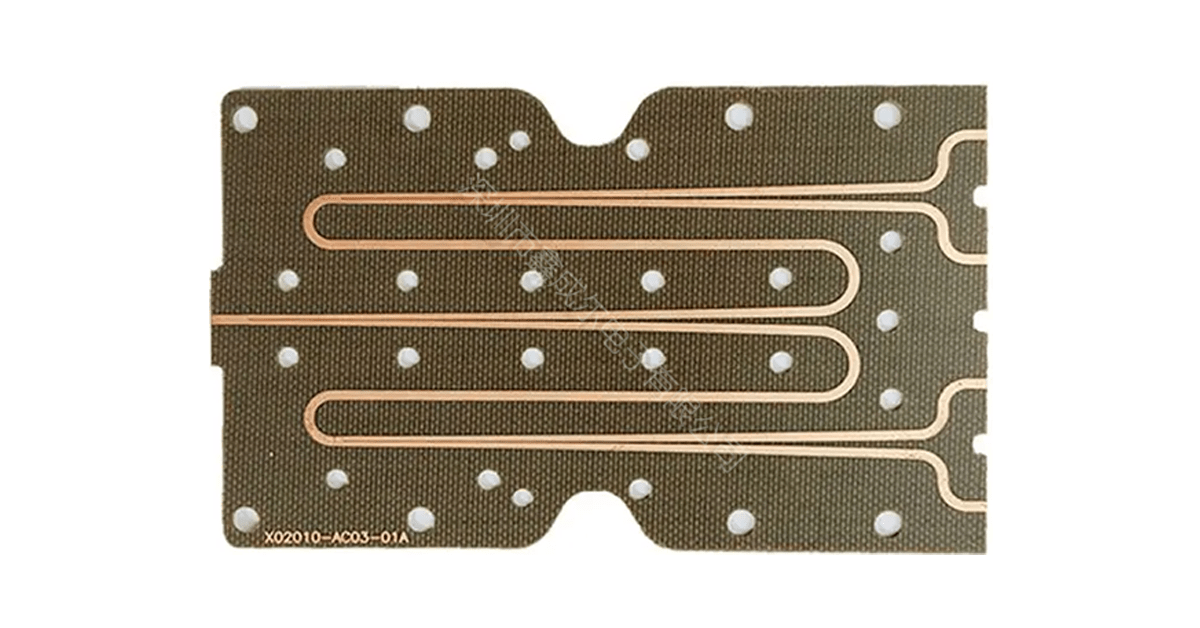
What the TLX Series Is
Taconic has coated fiberglass fabric with PTFE for more than 35 years, and TLX is the product line built on that process: a PTFE/woven-glass copper-clad laminate with tightly controlled electrical and mechanical properties. The dielectric constant spans 2.45 to 2.65 and can be specified anywhere in that range with a tolerance of ±0.04, measured at 10 GHz per IPC-TM-650 2.5.5.5. Dissipation factor is approximately 0.0019 at 10 GHz for the series.
The woven glass is the point. Compared with lightly reinforced PTFE grades such as the TLY series, the full fabric weave gives TLX the rigidity to be sheared, drilled, milled and plated with standard PTFE/woven-glass methods, and the dimensional stability that low-layer-count microwave panels and large antenna formats need. It also gives TLX a moisture absorption below 0.02% and a UL 94 V-0 flammability rating.
The Grade Ladder: TLX-0 Through TLX-6
Taconic adjusts glass content to shift Dk in controlled half-steps. Five catalog grades cover the window:
| Grade | Dk @ 10 GHz | Df @ 10 GHz (typical) | Where it sits |
|---|---|---|---|
| TLX-0 | 2.45 ± 0.04 | 0.0012–0.0019 | Lowest Dk and lowest loss of the family |
| TLX-9 | 2.50 ± 0.04 | ≈0.0019 | The datasheet reference grade |
| TLX-8 | 2.55 ± 0.04 | ≈0.0019 | The value most summaries misquote as “TLX” |
| TLX-7 | 2.60 ± 0.04 | ≈0.0020 | Upper-mid step |
| TLX-6 | 2.65 ± 0.04 | ≈0.0022 | Highest Dk, slightly higher loss |
If your stackup quotes a Dk between 2.45 and 2.65, name the grade on the drawing — “TLX” alone is not a specification. The Taconic family overview shows where TLX sits against the TLY, RF and TMS lines.
Reference Parameters (TLX-9 Typical Values)
| Property | Value | Design meaning |
|---|---|---|
| Dk / Df @ 10 GHz | 2.50 ± 0.04 / 0.0019 | Predictable impedance and phase |
| Moisture absorption | <0.02% | Outdoor and humidity-tolerant |
| Dielectric breakdown | >60 kV | High-power margins |
| Peel strength (1 oz ED) | 12 lb/in (≈2.1 N/mm) | Survives assembly handling |
| Thermal conductivity | 0.19 W/m·K | Typical PTFE-class; plan heat paths accordingly |
| CTE X-Y / Z | 9–12 / 130–145 ppm/°C | In-plane near copper; Z-axis still PTFE-like |
| Flammability | UL 94 V-0 | Commercial equipment eligible |
What the Woven Glass Buys — and What It Costs
- Buys rigidity. TLX panels handle shearing, routing and multilayer lamination registration with far less fuss than lightly reinforced PTFE. That is why TLX is the default for large-format antennas and low-layer-count microwave builds.
- Buys dimensional stability. The weave restrains movement through etch, lamination and thermal excursions, keeping artwork compensation modest.
- Costs a little loss. Df ≈0.0019 is roughly double the 0.0009 of the TLY series at 10 GHz. When every tenth of a dB in the antenna feed matters, designers step down to TLY-5: the TLY-5 analysis.
- Costs nothing on moisture. Sub-0.02% absorption means outdoor base station and marine environments do not move the impedance.
Where TLX Is Specified
| Application | Why TLX fits |
|---|---|
| Radar systems and phased-array antennas | Tight Dk tolerance keeps element-to-element phase consistent |
| LNAs, LNBs, LNCs | Low loss protects noise figure at the front end |
| Mobile communication / base station RF | V-0 rating and moisture immunity for outdoor hardware |
| Power amplifiers and passive components | >60 kV breakdown and stable Dk under load |
| Microwave test equipment and transmission devices | Repeatability matters more than ultimate loss |
Fabrication Notes
- Not an FR-4 line item. TLX is a PTFE laminate; it needs a PTFE-capable process — dedicated drilling parameters, plasma or sodium-naphthalene hole activation before electroless copper, and PTFE-compatible lamination. Do not plan it on a standard FR-4 bottleneck.
- Multilayer joining follows the same bond system as other woven PTFE laminates — FEP or low-flow prepreg routes. The mechanics are covered in the PTFE lamination walkthrough.
- Z-axis CTE stays PTFE-class (130–145 ppm/°C). Hole plating rules — adequate copper plating thickness and restrained aspect ratios — keep PTH reliability through thermal cycling.
- Copper cladding is typically 1/2, 1 or 2 oz electrodeposited on one or both sides; alternate claddings are orderable.
Specifying TLX With XCE PCB
XCE PCB builds Taconic TLX boards from 2 to 72 layers with impedance control to ±10%, panels up to 600 × 1200 mm, and samples in as fast as 24 hours when laminate is in stock. Tell us the grade (TLX-0 through TLX-6), the dielectric thickness and the copper weight — not just “TLX” — and we will quote the exact build. For the wider Taconic portfolio, start at the laminate family overview.
Frequently Asked Questions
What is the dielectric constant of Taconic TLX?
How does TLX differ from the TLY series?
Can TLX be processed like FR-4?
Is TLX flame retardant?
What thicknesses does TLX come in?
Building With Taconic TLX?
Send us your Gerber files and requirements for a manufacturability review and a tailored quotation.
sales1@xcepcb.com
+86 180 3341 4657