
High frequency PCB circuit boards use low loss materials (such as PTFE, Rogers board) and precision processes to ensure stable signal transmission. They are widely used in fields such as 5G base stations, high-speed digital devices, and automotive radar. Selection should pay attention to frequency, temperature, and design details.
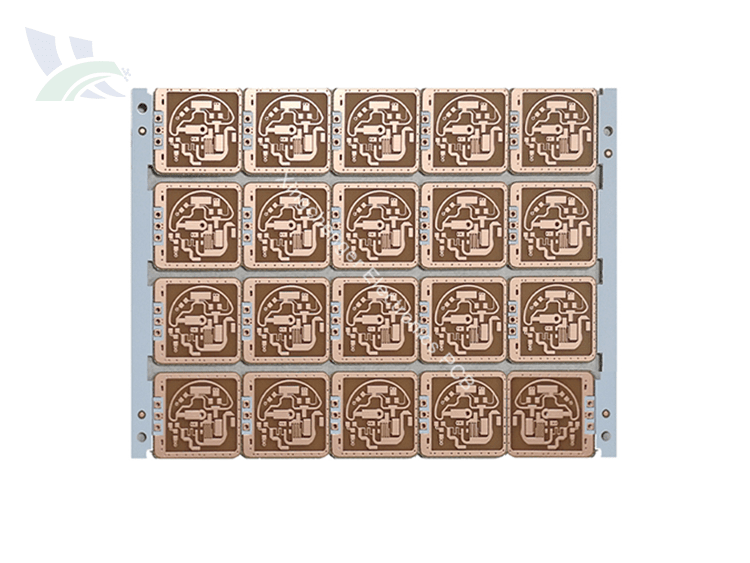
High frequency PCB circuit board is a specialized circuit board designed for the transmission of high-frequency signals (usually>300MHz or above), made of low loss materials (such as PTFE, Rogers board), with the core goal of reducing signal attenuation and ensuring transmission stability.
Core materials and manufacturing processes
The performance of high-frequency PCBs is highly dependent on material selection and precision processes:
Low loss substrate: Priority should be given to materials with extremely low dielectric constant (Dk) and loss factor (Df), such as:
PTFE (polytetrafluoroethylene): such as Rogers RO4000 series, Df can be as low as 0.001, suitable for microwave frequency band.
Ceramic filled composite materials, such as RO4350B, balance cost and performance, suitable for 5G base stations.
Key process requirements:
Ultra smooth copper foil: To reduce skin effect losses, reverse foil (RTF) is required.
Impedance control: Line width tolerance within ± 5 μ m, lamination alignment error<50 μ m.
Surface treatment: Chemical nickel gold deposition (ENIG) is used to prevent oxidation, and tin spraying is prohibited to prevent impedance changes.
Core application scenarios
High frequency PCB solves the three major challenges of high-speed signal transmission:
Wireless communication: 5G base station (millimeter wave frequency band), satellite antenna, using Rogers board to reduce signal attenuation by 30%.
High speed digital equipment: 400G optical module, server backplane, requiring HDI blind buried hole technology to reduce crosstalk.
High reliability fields: automotive radar (77GHz), aerospace electronics, relying on metal substrates (such as thermoelectric separation copper substrates) for heat dissipation.
Selection and Design Points
Parameter priority:
When the frequency is greater than 1GHz, the Df value needs to be less than 0.005 (such as RT/duroid 6002, Dk=3.0).
When the working temperature is greater than 100 ℃, choose materials with a glass transition temperature (Tg) ≥ 180 ℃.
Design to avoid pitfalls:
Avoid wiring at the edge of the board: The electromagnetic radiation at the edge increases the loss, and it needs to be inwardly shrunk by more than 3mm.
Grounding strategy: Multi point grounding is used for digital signals, and single point grounding is used for RF modules.