
The RO4000 series was engineered for a specific commercial insight: most “high-frequency” products — radar sensors, telecom radios, security systems — need PTFE-class electricals but FR-4-class economics. RO4350B and RO4835 deliver exactly that pairing, and the 24 GHz security radar market shows how the two divide the work.
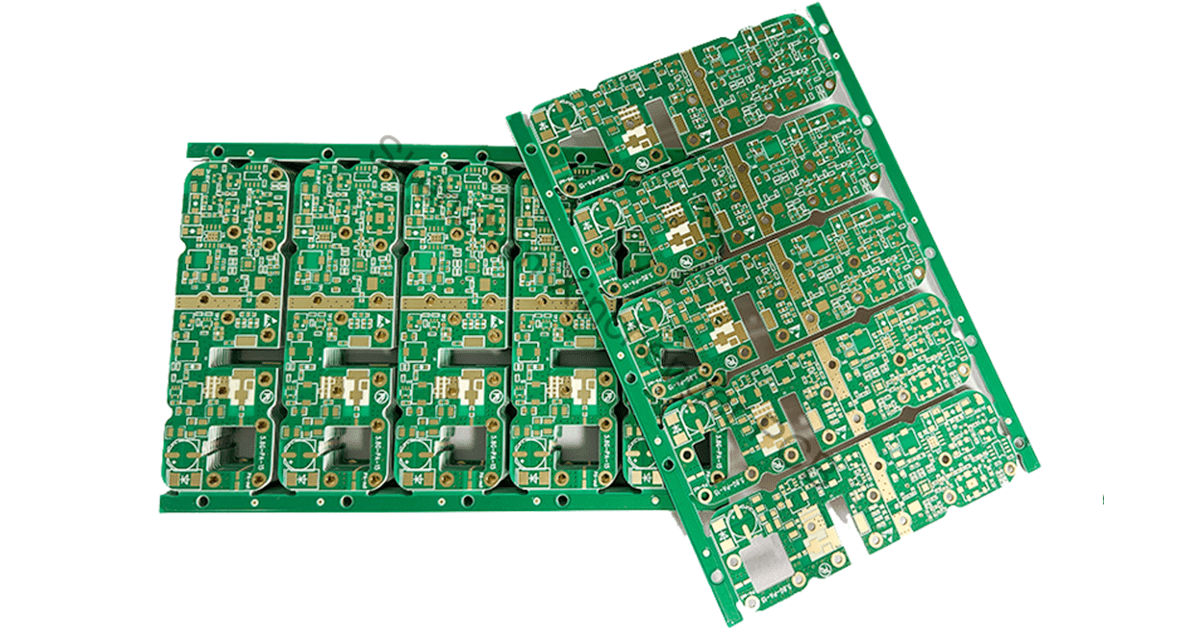
The Platform: PTFE-Class Electricals at FR-4 Economics
Both laminates are glass-fabric reinforced, ceramic-filled hydrocarbon thermosets — the RO4000 formula. The platform idea is threefold:
- Process: fully compatible with standard epoxy/glass (FR-4) manufacturing, including mixed lamination with FR-4 layers and lead-free soldering. No PTFE activation, no special through-hole treatment — fabricators with basic capabilities qualify, which is what keeps fabrication cost near FR-4 levels.
- Electricals: Dk 3.48 ± 0.05 and Df 0.0037 @ 10 GHz for both materials, with design Dk 3.66 — low-loss territory that FR-4 (Df roughly 0.02) cannot reach.
- Compliance: UL 94 V-0 flammability, RoHS, lead-free process — the checkboxes commercial products need without a second look.
The two flagships differ by one formulation decision, detailed against official values in our 4350B vs 4835 comparison.
The Two Flagships, Per the Official Datasheets
| Property | RO4350B | RO4835 |
|---|---|---|
| Dk / design Dk | 3.48 ± 0.05 / 3.66 | 3.48 ± 0.05 / 3.66 |
| Df @ 10 GHz | 0.0037 | 0.0037 |
| TCDk (−50 to 150 °C) | +50 ppm/°C | +50 ppm/°C |
| CTE (X/Y/Z) | 10 / 12 / 32 | 10 / 12 / 31 |
| Thermal conductivity | 0.69 W/m·K | 0.66 W/m·K |
| Antioxidant / IPC-4103 | — / /11 | 10× oxidation resistance / /11 & /240 |
The only functional difference is the antioxidant package: RO4835 trades nothing electrically — the datasheets are equivalent — and gains roughly 10× the oxidation resistance of standard thermosets. One correction to circulating claims: older texts describe RO4835 as having worse Z-axis expansion, temperature stability or phase behavior; its own datasheet shows Z-CTE 31 ppm/°C (marginally better than 4350B’s 32) and identical TCDk. Specify from the datasheet.
The Case Market: 24 GHz Security Radar
Security radar shows why this platform wins commercially. A typical 24 GHz security radar operates at 24–24.25 GHz with 250 MHz bandwidth, FMCW waveform. Physics sets the material requirement: at that frequency and wavelength, the RF front-end and antenna must use genuine microwave laminates — FR-4’s loss makes the detection range collapse. Economics sets the second requirement: the security industry is brutally competitive, so the material must deliver high performance and a strong price-performance ratio in volume.
RO4350B and RO4835 answer both sides: PTFE-class loss at 24 GHz with FR-4-compatible fabrication cost. That combination — not any single property — is why the pair carries so much of the market.
How the Two Split the Market
| Segment | Typical choice | Logic |
|---|---|---|
| Cost-driven security sensors, high volume | RO4350B | Identical electricals, mature supply, lowest landed cost |
| Outdoor sensors with 10-year duty, hot enclosures | RO4835 | Antioxidant covers thermal aging over the product life |
| Contracts specifying IPC-4103 slash sheets | RO4835 | /11 and /240 compliance documented |
| Point-to-point microwave links, PAs | RO4835 | Continuous high-temperature duty is the oxidation case |
Because the two process identically, a security radar maker can qualify once and choose per product line — the fabricator sees no changeover. The automotive-radar version of this decision is in our radar applications analysis.
Beyond the Flagships: The Rest of the RO4000 Family
The platform extends around the two laminates: RO4003C (lowest loss in the family at Df 0.0027, non-brominated, no UL 94 rating), RO4400 series bonding prepreg for multilayers built on RO4000 cores, and LoPro low-profile copper foil for low insertion-loss designs. The full-family trade space is mapped in our Rogers selection guide.
How XCE PCB Builds on RO4000
XCE PCB builds RO4350B, RO4835 and hybrid FR-4 stack-ups from 2 to 72 layers, impedance controlled to ±10% with TDR coupons on the production panel, panels up to 600 × 1200 mm, samples in as fast as 24 hours when laminate is in stock. Production controls: the manufacturing process guide; problem prevention: the production issues analysis.
Frequently Asked Questions
What makes the RO4000 series a commercial platform?
Are RO4350B and RO4835 electrically identical?
Why is 24 GHz security radar a showcase application for these materials?
Which of the two should a security radar maker choose?
Is RO4835 worse than RO4350B in temperature stability or layer count?
Build on the RO4000 Platform With XCE PCB
Send us your Gerber files and requirements for a manufacturability review and a tailored quotation.
sales1@xcepcb.com
+86 180 3341 4657