
FR-4 balances cost, manufacturability and adequate electricals — until the design’s basis is the dielectric itself. RT/duroid 5880 exists for that case: Dk 2.20 ± 0.02, Df 0.0009 @ 10 GHz, the lowest loss of any reinforced PTFE laminate, in a glass-microfiber composite whose properties hold from DC to Ku-band and above. This is the material-level walkthrough.
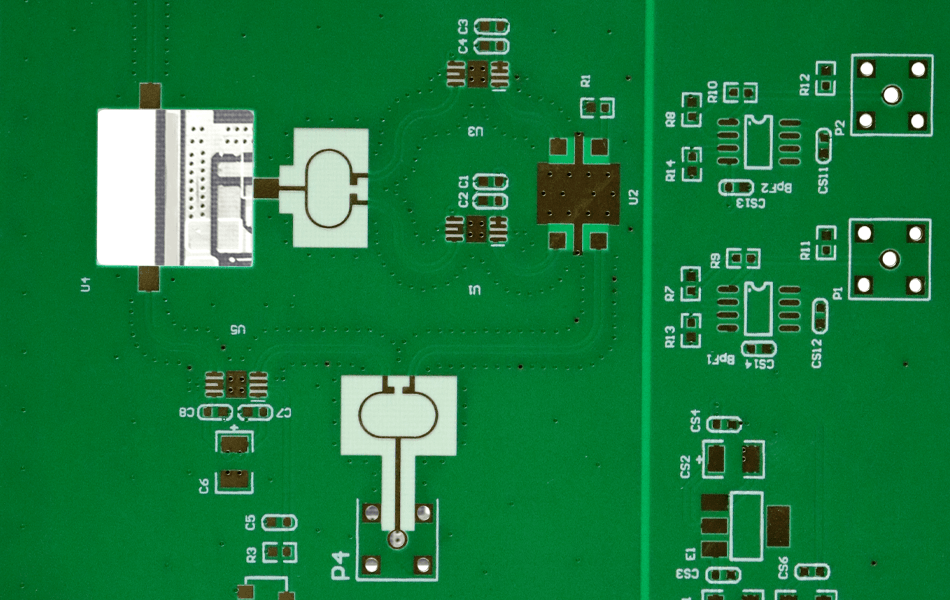
RT/duroid 5880 is a PTFE matrix reinforced with glass microfibers that are randomly oriented through the resin. Two consequences matter to users. First, the random orientation makes the laminate isotropic — Dk is the same in every direction, so filters and coupled structures behave as simulated even when routing turns corners. Second, there is no woven-glass cloth, hence no weave-induced Dk variation across the panel and no fiber-weave effect on skewed differential pairs at very high data rates.
Cladding options are broad: ED copper in 1/2, 1 and 2 oz, rolled copper, and metal-back configurations (aluminum, brass) for heat-sinking assemblies.
| Property | RT/duroid 5880 |
|---|---|
| Dk (process, 10 GHz) | 2.20 ± 0.02 |
| Df (10 GHz) | 0.0009 |
| TCDk (−50 to +150 °C) | −125 ppm/°C |
| CTE X / Y / Z | 31 / 48 / 237 ppm/°C |
| Thermal conductivity | 0.20 W/m·K |
| Moisture absorption | 0.02% |
| Td / flammability | >500 °C / UL 94 V-0 |
Beware copied parameter sets that attach other families’ numbers (Df 0.0027, CTE 13/13/60) to this material — the correction history is documented in our 5880 parameter guide.
FR-4’s Dk (~4.4) carries ~20× the loss at microwave frequencies, drifts with resin content and absorbed water, and its woven-glass construction adds local Dk variation. For digital boards below a few GHz that economics wins. The line where 5880 takes over:
One physics footnote worth knowing in design reviews: dielectric breakdown. Any insulator conducts suddenly above a critical field strength; 5880’s PTFE chemistry holds a high breakdown strength, which is part of why the material also serves in power-carrying RF structures. The full-family selection logic is in our Rogers vs PTFE selection guide.
XCE PCB builds RT/duroid 5880 boards from 2 to 72 layers across all standard core thicknesses, impedance controlled to ±10%, panels up to 600 × 1200 mm, with sodium-naphthalene hole treatment as standard. Samples in as fast as 24 hours when laminate is in stock. Continue with the 5880 laminate overview, the unique-advantages analysis and the low-loss analysis.
Send us your Gerber files and requirements for a manufacturability review and a tailored quotation.