
Two numbers circulate about Taconic RF-30, and one of them is badly wrong. The Dk of 3.0 is correct. The “Df around 0.003” you will find in copied summaries is not: the datasheet measures 0.0014 at 1.9 GHz — less than half the circulated value, and the entire reason RF-30 exists as a base-station antenna laminate. This guide rebuilds the parameter set from the datasheet, then maps applications and the production steps that actually matter.
What RF-30 Is
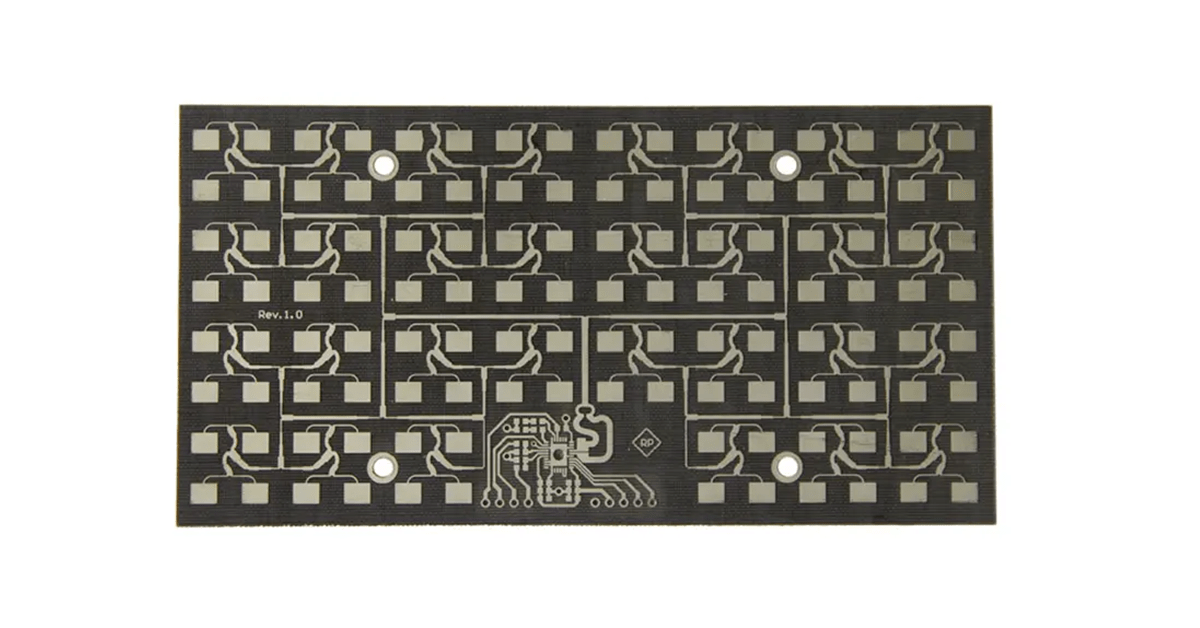
RF-30 is a ceramic-filled, woven-glass-reinforced PTFE laminate — Taconic’s value-oriented workhorse for RF and microwave antenna hardware. The ceramic loading plus fabric reinforcement give it mechanical stability that pure PTFE lacks, while the PTFE matrix keeps loss far below hydrocarbon laminates. Its production sweet spot is long-format base station antennas (up to roughly 102 inches), where low passive intermodulation (PIM), smooth copper profile and cost all matter at once.
One caution that follows from the circulating errors: if a stackup drawing quotes RF-30 with Df 0.003, it is quoting a loss twice the real figure — which distorts both the link budget and the supplier comparison. Correct it at design time.
Datasheet Parameters (Corrected)
| Property | Datasheet value | Note |
|---|---|---|
| Dielectric constant | 3.00 ±0.04 @ 1.9 GHz / 23 °C | Woven glass + ceramic PTFE construction |
| Dissipation factor | 0.0014 @ 1.9 GHz | Circulated “0.003” is wrong by >2× |
| CTE X / Y / Z | 11 / 21 / 125 ppm/°C | In-plane well matched to copper |
| Moisture absorption | 0.02% | Outdoor-tolerant |
| Dielectric breakdown | >60 kV | High-power margin |
| Peel strength | 10 lb/in | Survives assembly handling |
| Flammability | UL 94 V-0 | Commercial equipment eligible |
On thickness: laminated cores ship in multiple dielectric thickness classes; 30 mil (0.762 mm) and 40 mil (1.016 mm) are the commonly stocked antenna-panel builds, with thinner RF-core classes available for multilayer stackups. The “0.076–0.508 mm” range quoted in older summaries does not match how RF-30 is actually supplied — confirm the class at quoting rather than inheriting it.
Where RF-30 Sits in the Taconic RF Family
| Grade | Dk | Distinctive role |
|---|---|---|
| RF-30 | 3.00 | Lowest-loss of the mid-Dk antenna line; base station panels |
| RF-35 | 3.50 | Industry-standard antenna grade; PA and coupler builds |
| RF-60A | 6.15 | Miniaturization where Dk is the lever |
| RF-10 | 10.2 | GNSS/patch antennas, maximum size reduction |
Family context and the properties behind these roles: the Taconic overview and the laminate guide.
Applications
- Base station antennas. The signature use: long-format panels where low Df preserves the feed budget, smooth copper and tight etch control limit phase spread, and low PIM keeps receiver sensitivity intact under high transmit power.
- RF passive components. Filters, couplers, dividers and baluns that need stable Dk at antenna-line volumes.
- Power amplifiers. >60 kV breakdown and V-0 rating support high-power pallet work, though RF-35 or TMS-DS3 are the usual upgrades when heat extraction dominates.
- Radar, satellite and automotive RF. Qualified uses across commercial and defense hardware; for 77–79 GHz automotive radar specifically, Taconic’s NF-30 is the purpose-built grade.
- Test and industrial RF fixtures. Repeatability and cost favor RF-30 where ultimate millimeter-wave loss is not the constraint.
Production Notes
- It is still a PTFE laminate. RF-30 requires a PTFE-capable line: plasma or sodium-naphthalene hole-wall activation before electroless copper, PTFE-compatible drilling and press cycles. The hole-prep logic is the same family as other reinforced PTFE boards — see the surface treatment guide.
- Laminate does not flow. Bonding multilayer RF-30 stackups uses film or low-flow prepreg systems with symmetric layups; the press-temperature window is chosen per bond system, not “hot pressed” generically.
- Surface finishes. ENIG and OSP are the common choices for solderability; immersion tin and immersion silver appear on antenna builds where flatness and low-loss finishes matter.
- Quality release. Each laminate shipment is tested to IPC-TM-650 with a certificate of conformance; at the board level, impedance coupons and 100% electrical test close the loop.
Specifying RF-30 With XCE PCB
XCE PCB builds RF-30 boards on a PTFE-capable line: 2–72 layers, impedance ±10%, panels to 600 × 1200 mm, samples in as fast as 24 hours with laminate in stock. Quote with the dielectric class, copper weight and finish named explicitly — and if your inherited drawing says Df 0.003, send it back for the datasheet value first.
Frequently Asked Questions
What is the dissipation factor of Taconic RF-30?
What is the dielectric constant of RF-30?
Why is RF-30 popular for base station antennas?
What thicknesses does RF-30 come in?
Does RF-30 process like FR-4?
Quoting an RF-30 Build?
Send us your Gerber files and requirements for a manufacturability review and a tailored quotation.
sales1@xcepcb.com
+86 180 3341 4657